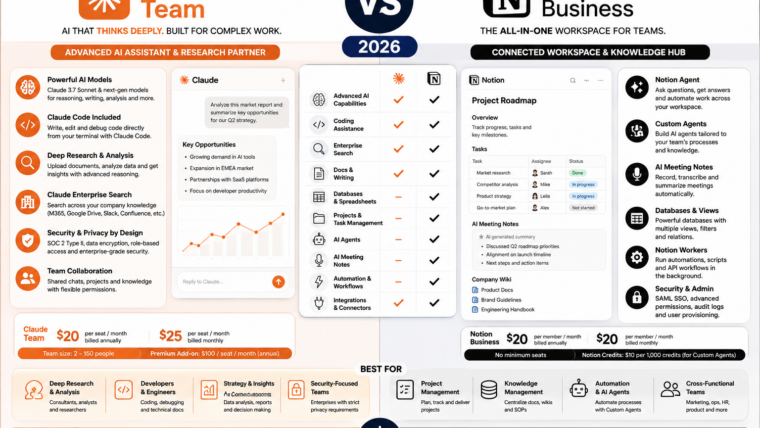
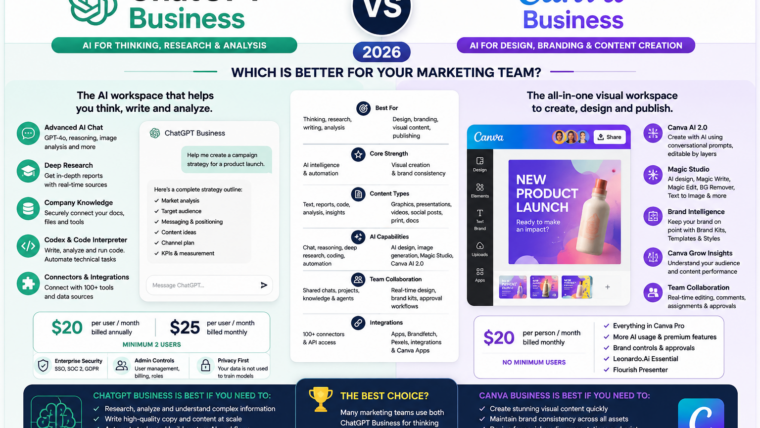
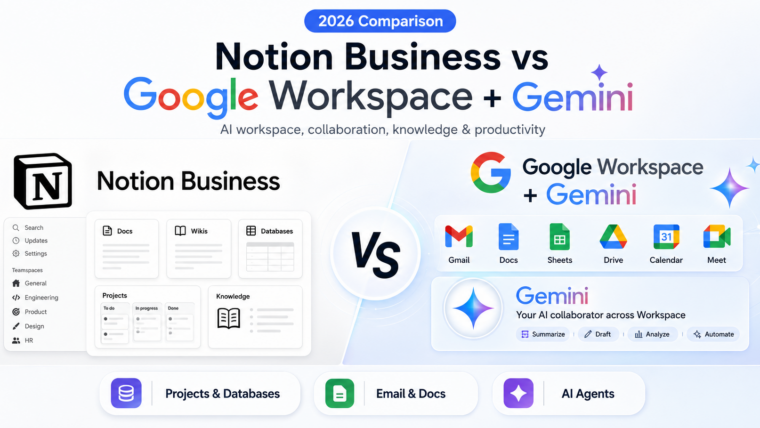
ChatGPT Business and Notion Business now overlap far more than they did a year ago.
ChatGPT is no longer simply a chatbot. Its Business plan combines company context, connected tools, custom team agents, analysis, file work, coding, administration and a growing plugin ecosystem.
Notion is no longer simply a notes and project-management app. Its Business plan now includes Notion Agent, Enterprise Search, AI Meeting Notes, Custom Agents, advanced database workflows and an increasingly agentic automation layer built around Notion’s structured company knowledge.
The most interesting part is price: both products currently sit around the same $20 per user or member per month headline level, although ChatGPT Business requires at least two users and is $20 per user when billed annually, while Notion offers monthly and annual billing structures and advertises savings for yearly billing.
So which one gives a small or growing business more value?
In this ChatGPT Business vs Notion Business comparison, we examine pricing, general AI capability, company knowledge, writing, databases, projects, agents, automation, meetings, coding, connected tools, privacy, administration and which platform fits different types of teams in 2026.
ToolMetria methodology: This comparison uses current official OpenAI and Notion documentation together with our editorial framework. We will add standardized hands-on scores after testing equivalent workflows in both products.
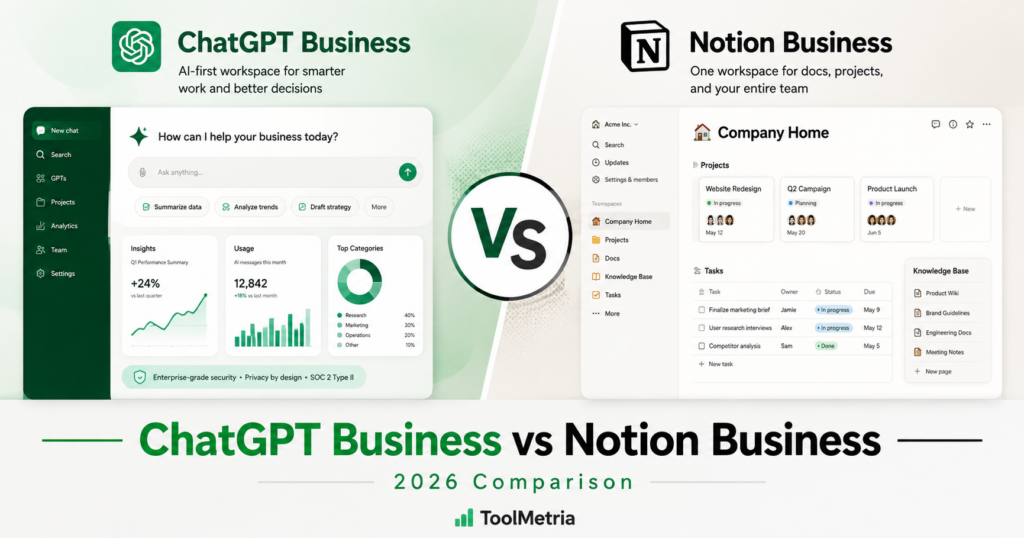
ChatGPT Business vs Notion Business: Quick Answer
Choose ChatGPT Business if you want the broader dedicated AI workspace.
Choose Notion Business if your company wants AI embedded directly inside its documentation, projects, databases, meeting notes and internal knowledge system.
For a mixed team that wants one powerful AI platform across many different types of work, ChatGPT Business is our current preference.
For a company that already runs its operations inside Notion, Notion Business can create more value because the AI is operating directly on the workspace where the work already exists.
| Category | Winner | Why |
|---|---|---|
| Headline price | Tie | Both sit around $20/user or member per month |
| General AI capability | ChatGPT Business | Broader AI-first workspace |
| Documents and wiki | Notion Business | Native core product |
| Projects and databases | Notion Business | Structured project/database layer is built in |
| Company knowledge | Tie | Company Knowledge vs Enterprise Search + native Notion context |
| Agents | Tie | Team agents/plugins vs Notion Agent + Custom Agents |
| Automation inside workspace | Notion Business | Custom Agents, Workers and database-native workflows |
| Cross-tool AI | ChatGPT Business | Broader connected-tool and plugin ecosystem |
| Coding | ChatGPT Business | ChatGPT + Codex access is part of the Business offering |
| Meetings | Notion Business | AI Meeting Notes is built into the workspace |
| File/data analysis | ChatGPT Business | Stronger general analysis environment |
| Structured operational workflows | Notion Business | Databases + agents + Workers |
| Best for mixed small businesses | ChatGPT Business | More general-purpose |
| Best for Notion-centric teams | Notion Business | AI works directly inside existing company context |
Read the full individual reviews: ChatGPT Business Review and Notion Business Review.
Pricing: Similar Headline Cost, Different Value
OpenAI currently lists ChatGPT Business at:
- $20 per user per month when billed annually;
- $25 per user per month when billed monthly;
- minimum 2 users.
Notion’s current pricing page lists Business at $20 per member per month and offers monthly and yearly billing options, with advertised savings on annual billing.
| Product | Headline business price | Minimum team requirement |
|---|---|---|
| ChatGPT Business | $20/user/month annual, $25 monthly | 2 users |
| Notion Business | $20/member/month displayed price | No equivalent two-seat Business minimum highlighted on pricing page |
The price is close enough that it should not be the main deciding factor.
The better question is:
Which product replaces more software and recurring work?
What You Actually Buy with ChatGPT Business
ChatGPT Business is an AI workspace first.
OpenAI currently lists features including:
- ChatGPT;
- Codex access;
- chat, coding, analysis and workflow capabilities;
- connections to Microsoft 365, Google Drive, Slack, GitHub, Linear, Figma and more;
- company knowledge and team context;
- custom team agent plugins;
- centralized billing and administration;
- usage analytics;
- budgeting and spend controls;
- SAML SSO;
- MFA;
- business data not used for training by default.
This is designed to sit across many departments rather than replace one specific productivity application.
What You Actually Buy with Notion Business
Notion Business is a workspace first.
The plan combines:
- documents;
- wikis;
- projects;
- databases;
- forms;
- Notion Agent;
- Enterprise Search;
- AI Meeting Notes;
- advanced permissions;
- SAML SSO;
- private teamspaces;
- verified pages;
- Custom Agents and advanced agent workflows.
This means Notion can potentially replace several products while also supplying AI inside the same environment.
General AI Capability: ChatGPT Business Wins
ChatGPT is the stronger choice when the task does not naturally belong in a project page, database or wiki.
Typical ChatGPT Business workflows include:
- research;
- data analysis;
- file analysis;
- coding;
- marketing strategy;
- sales preparation;
- document drafting;
- cross-tool company knowledge;
- custom AI workflows.
Notion AI can perform many intelligent tasks, but its greatest advantage appears when the work is already connected to Notion.
Winner: ChatGPT Business
Documents and Wiki: Notion Business Wins
Notion is the stronger document and wiki platform because these are native parts of the product.
A company can organize:
- policies;
- project documentation;
- meeting notes;
- product specs;
- research;
- onboarding;
- internal guides;
- operating procedures.
Notion Agent can then work directly with that content.
ChatGPT can create and analyze documents, but it does not replace a full collaborative company wiki in the same way.
Winner: Notion Business
Projects and Databases: Notion Business Wins Clearly
This is one of the biggest differences.
Notion databases can function as:
- project trackers;
- content calendars;
- lightweight CRMs;
- roadmaps;
- task systems;
- research repositories;
- asset libraries;
- operational dashboards.
AI can then interact with this structured information.
ChatGPT can analyze project information, but it is not itself a native project database environment.
Winner: Notion Business
Company Knowledge: Two Strong Approaches
ChatGPT Company Knowledge
ChatGPT Company Knowledge lets Business users search eligible connected business sources and generate company-specific answers with citations.
The broader OpenAI business ecosystem can connect to tools such as:
- Microsoft 365;
- Google Drive;
- Slack;
- GitHub;
- Linear;
- Figma;
- other supported business systems.
This is useful when company information is spread across many different products.
Notion Enterprise Search
Notion Business includes Enterprise Search.
It can search:
- the Notion workspace;
- structured Notion databases;
- supported connected business tools;
- company knowledge sources.
Notion’s advantage is that a large portion of the company’s knowledge may already exist directly inside the workspace.
Winner: Tie
Choose ChatGPT when information is scattered across many external systems.
Choose Notion when Notion itself is already the company knowledge center.
Important ChatGPT Company Knowledge Limitation
OpenAI’s current Company Knowledge documentation says the feature is available on ChatGPT Web and is not currently supported in the desktop or mobile applications.
Other ChatGPT capabilities still work across supported apps, but teams should understand this limitation if Company Knowledge is a central workflow.
Notion Agent
Notion Agent is designed to work directly on company context.
Potential workflows include:
- creating project plans;
- updating databases;
- organizing documents;
- researching internal knowledge;
- building reports;
- generating structured pages;
- working across projects and company content.
This makes it especially useful when the task needs to change the workspace rather than merely answer a question.
Custom Agents: Notion’s Biggest 2026 Shift
Notion launched Custom Agents in 2026 as autonomous AI teammates.
Instead of manually prompting them every time, a Custom Agent can:
- run on a trigger;
- run on a schedule;
- perform repeated work;
- use approved company context;
- interact with connected tools;
- log every run.
Notion gives examples such as:
- internal Q&A;
- task triage;
- daily standups;
- status reports;
- inbox workflows.
Custom Agent Costs: Important Difference
Notion Custom Agents use a credit-based model.
That means the $20 Business plan is not necessarily the full cost of advanced autonomous automation.
Notion introduced credits so businesses pay based on the amount of Custom Agent work performed.
Administrators can also set limits on which users can create agents and how much individual agents are allowed to spend.
This gives control but makes cost forecasting more complex.
ChatGPT Team Agents and Plugins
ChatGPT Business also supports team agents built around company knowledge and team context through custom plugins.
The broader plugin directory can extend ChatGPT into business systems and supported actions.
ChatGPT’s biggest advantage is breadth.
A team agent does not need to be centered around a Notion database or page structure.
Winner: Tie
Notion is stronger for workspace-native autonomous operations.
ChatGPT is stronger for broad AI agent workflows across heterogeneous business tools.
Notion Workers
Workers push Notion further into automation.
Workers run custom code on Notion’s infrastructure and can:
- sync data;
- respond to webhooks;
- power tools used by Custom Agents;
- call external APIs;
- perform deterministic automation.
This is important because AI reasoning is not always the right way to execute a business step.
A Worker can perform a deterministic technical operation while a Custom Agent handles reasoning.
External Agents: Claude, Cursor and More
Notion 3.6 expanded the workspace so external agents can participate alongside human teammates.
Notion currently highlights integrations with agents such as Claude and Cursor.
Teams can assign work from shared boards and monitor agent activity alongside ordinary project work.
This positions Notion as an orchestration layer rather than simply one AI assistant.
AI Meeting Notes: Notion Business Wins
AI Meeting Notes is built directly into Notion Business.
The tool can:
- transcribe meetings;
- summarize discussions;
- identify action items;
- place meeting knowledge inside the company workspace.
In July 2026, Notion also added the ability for completed AI Meeting Notes to trigger Custom Agents.
A meeting can therefore automatically initiate workflows such as:
- updating a project tracker;
- posting a recap;
- creating engineering tickets;
- routing action items.
Winner: Notion Business
Writing: ChatGPT Business Wins for General Use
Both products can help with writing.
Notion has a major convenience advantage when the writing is already taking place inside a Notion page.
ChatGPT has the broader AI environment for:
- brainstorming;
- research-driven drafting;
- editing;
- multiple files;
- cross-tool context;
- complex iterative work.
Winner: ChatGPT Business overall
Coding: ChatGPT Business Wins
OpenAI’s Business pricing currently includes access to ChatGPT and Codex.
That makes the platform a stronger fit for software-development workflows.
Notion has Workers and external developer-agent integrations, but Notion Business itself is not primarily a coding workspace.
Winner: ChatGPT Business
A Current Codex Licensing Nuance
OpenAI changed dedicated Codex-seat availability in June 2026.
Its current Business help documentation says new dedicated Codex licenses are no longer available for new Business plans or workspaces that had never added one before June 24, 2026.
At the same time, OpenAI’s Business pricing page continues to list access to ChatGPT and Codex as part of ChatGPT Business.
Teams that need a specific dedicated Codex-seat structure should therefore verify the current licensing rules before purchase.
File and Data Analysis: ChatGPT Business Wins
ChatGPT is particularly useful when employees need to analyze information outside a structured Notion database.
Examples include:
- spreadsheets;
- PDFs;
- CSV files;
- documents;
- mixed datasets;
- one-off calculations;
- charts and reports.
Winner: ChatGPT Business
Structured Data and Operational Tracking: Notion Wins
Notion is stronger when the information needs to remain alive after the analysis.
For example, a team may want to:
- update a CRM-like database;
- change task status;
- maintain a roadmap;
- create a content calendar;
- track customer feedback;
- route work between teams.
Notion’s database structure is built for persistent operational information.
Winner: Notion Business
Connected Business Tools: ChatGPT Business Wins for Breadth
OpenAI currently highlights connections to tools such as:
- Microsoft 365;
- Google Drive;
- Slack;
- GitHub;
- Linear;
- Figma;
- many additional plugins.
Notion also supports important connectors and MCP-based workflows, but ChatGPT is more naturally positioned as a general AI layer over many different software ecosystems.
Winner: ChatGPT Business
Notion as a Replacement for Other Software
This is where Notion’s pricing can become more attractive than it initially appears.
Notion Business can potentially replace or reduce spending on:
- wiki software;
- project-management software;
- meeting-note tools;
- lightweight CRM systems;
- internal knowledge tools;
- some automation tools.
ChatGPT Business is more likely to supplement the company’s existing software than replace the entire project/document infrastructure.
Privacy: Both Are Strong Business Products
OpenAI states that business data is not used for model training by default.
Notion provides business-oriented workspace permissions, SAML SSO and administrative controls around AI and Custom Agents.
Companies should still review their own regulatory and contractual requirements before placing sensitive information into any AI product.
Winner: Tie for ordinary small-business requirements
Administration: Different Strengths
ChatGPT Business includes:
- centralized billing;
- usage analytics;
- budget planning;
- spend controls;
- SAML SSO;
- MFA;
- workspace administration.
Notion Business includes controls around:
- workspace permissions;
- private teamspaces;
- database access;
- SAML SSO;
- verified pages;
- Custom Agent creation;
- agent spending limits;
- workspace structure.
Winner: Tie
Which Is Better for a Startup?
Notion can be extremely useful as a startup operating system.
A small team can organize:
- roadmap;
- company wiki;
- tasks;
- meeting notes;
- customer research;
- content;
- product documentation;
- AI agents.
ChatGPT is stronger when the startup wants a broad AI layer across engineering, research, marketing and operations.
Many startups will eventually use both.
Which Is Better for Agencies?
ChatGPT Business is stronger for client research, strategy, analysis and general AI work.
Notion Business is stronger for client portals, project tracking, documentation, content calendars and operational systems.
If forced to choose one, pick based on whether the agency’s bigger pain is:
doing the work faster → ChatGPT
or:
organizing the work better → Notion.
Which Is Better for Marketing Teams?
ChatGPT is stronger for:
- research;
- strategy;
- writing;
- analysis;
- cross-tool workflows.
Notion is stronger for:
- content calendars;
- campaign tracking;
- briefs;
- asset databases;
- meeting notes;
- workflow automation.
For visual production, see our Canva Business Review.
Which Is Better for Developers?
ChatGPT Business.
Codex access and the broader developer-oriented ecosystem make it the stronger primary AI product for coding teams.
Notion can still be excellent as the documentation and project layer surrounding development.
Which Is Better for Operations?
Notion Business has a strong argument.
Databases, Custom Agents, Workers, webhooks, meeting triggers and project context make it well suited to recurring operational systems.
ChatGPT is stronger when operations involves ad-hoc analysis across many disconnected tools.
Can Notion Business Replace ChatGPT Business?
For some teams, yes.
If most AI usage involves:
- internal documentation;
- project updates;
- database workflows;
- meeting notes;
- company search;
- recurring internal automation;
then Notion Business may be enough.
If employees regularly need:
- coding;
- general research;
- advanced file analysis;
- cross-tool AI;
- broad business assistance;
ChatGPT Business remains meaningfully different.
Can ChatGPT Business Replace Notion?
Usually not if the organization uses Notion as a real operational system.
ChatGPT is not a direct replacement for:
- project databases;
- team wiki structure;
- roadmaps;
- persistent task tracking;
- collaborative operational dashboards.
It can help create and analyze that information, but the information still needs somewhere structured to live.
Do You Need Both?
For many knowledge-work teams, yes — eventually.
A strong stack can look like:
- Notion Business = where the company organizes projects and knowledge;
- ChatGPT Business = AI layer for research, analysis, coding and broader workflows.
But do not buy both automatically.
Start with the platform that solves the larger recurring problem.
Final Scorecard
| Category | ChatGPT Business | Notion Business |
|---|---|---|
| Headline price | Tie | Tie |
| General AI | Winner | Strong |
| Documents/wiki | AI-assisted | Winner |
| Projects/databases | Not native | Winner |
| Company knowledge | Excellent | Excellent |
| Agents | Excellent | Excellent |
| Workspace automation | Strong | Winner |
| Cross-tool AI | Winner | Strong |
| Coding | Winner | External/developer tooling |
| Meeting notes | Can summarize supplied content | Winner |
| File/data analysis | Winner | Strong in workspace context |
| Operational tracking | Not core product | Winner |
| Mixed small business | Winner | Strong |
| Notion-centric team | Complementary | Winner |
Our Recommendation
Choose ChatGPT Business if your main goal is to give employees one powerful AI workspace for research, analysis, coding, files, company context and general business work.
Choose Notion Business if your main goal is to build an AI-native operating system around documents, projects, databases, meetings and internal knowledge.
At approximately the same headline seat price, the difference is simple:
ChatGPT helps your team do more kinds of work.
Notion helps your team organize and automate the work that lives inside the company workspace.
Frequently Asked Questions
Is ChatGPT Business the same price as Notion Business?
Both currently sit around a $20 per user or member per month headline price. ChatGPT Business is $20 per user per month on annual billing or $25 monthly and requires at least two users. Notion lists Business at $20 per member per month and offers annual billing savings.
Which is better for company knowledge?
Both are strong. ChatGPT Company Knowledge is better suited to information spread across many external business systems, while Notion Enterprise Search is especially compelling when Notion itself is the company knowledge base.
Which is better for project management?
Notion Business. Projects, databases and structured operational information are core parts of Notion.
Which is better for coding?
ChatGPT Business. OpenAI currently includes access to ChatGPT and Codex as part of the Business offering.
Which is better for AI agents?
It depends. Notion Custom Agents are particularly strong for recurring workspace-native workflows. ChatGPT team agents are stronger when the AI needs to operate across a broader mix of business tools.
Do Notion Custom Agents cost extra?
Custom Agents use Notion credits, so autonomous workflows can create additional usage costs beyond the Business subscription.
Does Notion include AI Meeting Notes?
Yes. Notion Business includes AI Meeting Notes, and meeting summaries can now trigger Custom Agents for automated follow-up workflows.
Does OpenAI train on ChatGPT Business data?
OpenAI states that business data is not used for model training by default.
Can I use ChatGPT Business and Notion Business together?
Yes. They are highly complementary: Notion can serve as the structured company workspace while ChatGPT provides a broader AI layer for research, analysis, coding and cross-tool work.
Final Verdict: ChatGPT Business or Notion Business?
ChatGPT Business is our winner as the dedicated AI workspace.
It is the better default when a mixed business team wants AI across many different types of work.
Notion Business is our winner as the AI-native company workspace.
Its combination of documents, databases, projects, Enterprise Search, AI Meeting Notes, Custom Agents and Workers makes it unusually powerful for teams that already organize their operations inside Notion.
The shortest possible recommendation:
ChatGPT Business = broader AI.
Notion Business = deeper workspace integration.
For more recommendations, see Best AI Tools for Small Business in 2026.