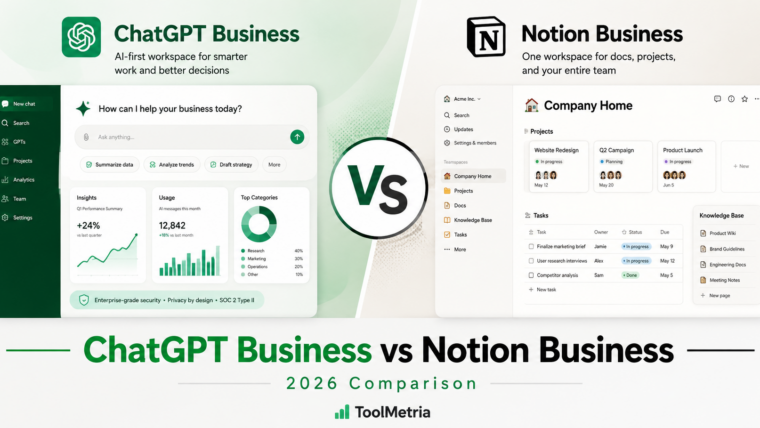
ChatGPT Business and Canva Business are two of the most useful AI subscriptions a marketing team can buy in 2026 — but they solve very different parts of the workflow.
ChatGPT Business is built around research, strategy, writing, analysis, coding, company knowledge, connected business tools and AI workflows.
Canva Business is built around visual production, brand consistency, presentations, social content, video, campaign assets, marketing insights and AI-assisted creative work.
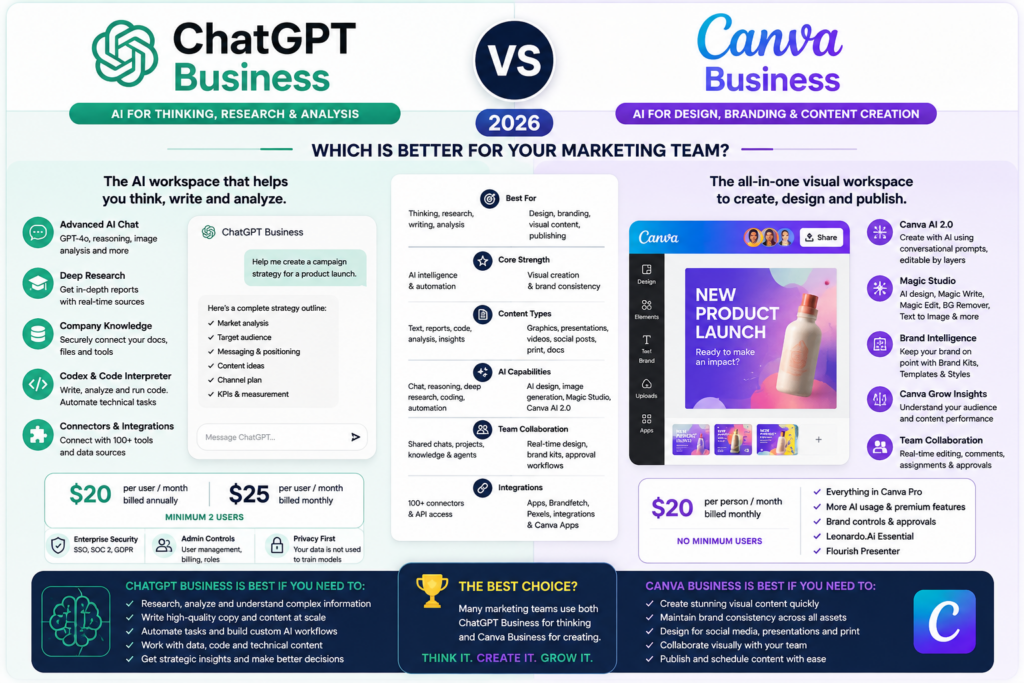
Both currently sit at a headline price of roughly $20 per user or person per month, but the economics are different. ChatGPT Business requires at least two standard users, while Canva Business explicitly has no seat minimum and can be used by a one-person business.
In this ChatGPT Business vs Canva Business comparison, we examine pricing, writing, research, image generation, design, brand management, campaigns, coding, presentations, video, team collaboration, AI limits, privacy and which platform delivers more value for different types of businesses.
ToolMetria methodology: This comparison is based on current 2026 official OpenAI and Canva documentation together with our editorial framework. We will add standardized hands-on scores after testing equivalent marketing workflows in both platforms.
ChatGPT Business vs Canva Business: Quick Answer
Choose ChatGPT Business if your main need is strategy, research, writing, analysis, coding and general-purpose AI across the company.
Choose Canva Business if your main need is producing branded visual content, presentations, campaigns, social assets, video and marketing creative at scale.
For a marketing department, these products are more complementary than competitive.
| Category | Winner | Why |
|---|---|---|
| Headline price | Tie | Both are around $20 per person/user per month |
| Solo business | Canva Business | No seat minimum; ChatGPT Business requires 2 standard users |
| General AI | ChatGPT Business | Broader AI-first workspace |
| Research | ChatGPT Business | Deep Research and general analytical workflows |
| Writing | ChatGPT Business | Stronger general-purpose drafting and editing environment |
| Design | Canva Business | Native visual editor and creative ecosystem |
| Brand management | Canva Business | Brand tools are core to the product |
| Social content | Canva Business | Design, resize, publish and scale creative production |
| Presentations | Canva Business | Native collaborative presentation workflow |
| Video | Canva Business | Native video creation and editing |
| Coding | ChatGPT Business | Codex access included with standard Business seats |
| Interactive experiences | Canva Business | Canva Code 2.0 targets interactive websites and experiences |
| Company knowledge | ChatGPT Business | Company Knowledge and business tool connections |
| Marketing creative production | Canva Business | Designed specifically for creative output at scale |
| Best all-round AI | ChatGPT Business | Useful across more departments |
Read the individual reviews: ChatGPT Business Review and Canva Business Review.
Pricing: Same Headline, Different Minimums
OpenAI currently lists ChatGPT Business at:
- $20 per user per month when billed annually;
- $25 per user per month when billed monthly;
- minimum 2 standard users.
That means the minimum ChatGPT Business annual-equivalent spend is approximately $40 per month.
Canva Business is currently listed at:
- $20 per person per month;
- no seat minimum.
A solo founder can therefore subscribe to Canva Business for $20, while a one-person company would normally compare ChatGPT individual plans rather than ChatGPT Business.
Winner for solo businesses: Canva Business
What ChatGPT Business Includes
OpenAI currently lists standard ChatGPT Business seats with access to:
- ChatGPT;
- Codex;
- GPTs;
- Projects;
- Apps;
- Company Knowledge;
- ChatGPT Agent;
- Deep Research;
- business tool connections;
- centralized billing and administration;
- SAML SSO and MFA;
- business data not used for training by default.
This makes ChatGPT Business useful far beyond marketing.
What Canva Business Includes
Canva Business includes everything in Canva Pro plus business-oriented capabilities such as:
- higher premium AI usage;
- team collaboration;
- advanced brand management;
- Canva Grow Insights;
- Leonardo.Ai Essential;
- Flourish Presenter;
- additional marketing capabilities;
- a 10% discount on eligible print orders.
Canva explicitly positions Business for individuals, marketers and small teams.
General AI: ChatGPT Business Wins
ChatGPT Business is the stronger choice when the work begins with a question rather than a design.
Typical workflows include:
- researching a market;
- building a campaign strategy;
- analyzing customer feedback;
- reviewing spreadsheets;
- writing copy;
- comparing competitors;
- working with internal company knowledge;
- coding or automation support.
Winner: ChatGPT Business
Design: Canva Business Wins Easily
Canva is a visual creation platform first.
Teams can create:
- social posts;
- ads;
- presentations;
- documents;
- video;
- sales collateral;
- brand assets;
- web content;
- campaign variations.
ChatGPT can generate ideas, copy, images and creative direction, but Canva provides the structured design environment where the final asset can be edited, approved and published.
Winner: Canva Business
Canva AI 2.0 Changes the Comparison
Canva introduced Canva AI 2.0 in 2026 as a major move toward a conversational and agentic creative platform.
Canva says the system can begin from:
- an idea;
- a goal;
- a brief;
- a sketch;
- an unfinished thought.
It can then generate fully layered and editable output rather than only a flat image.
That matters because professional marketing teams need to edit:
- headlines;
- images;
- fonts;
- layout;
- brand colors;
- individual elements.
Research: ChatGPT Business Wins
ChatGPT Business includes Deep Research and broad analytical capabilities.
It is better suited to:
- market research;
- competitive analysis;
- customer research;
- industry research;
- strategy;
- multi-source analysis.
Canva AI 2.0 now includes web research, which is useful because research can flow directly into creative work.
But research remains a secondary capability inside a creative platform.
Winner: ChatGPT Business
Writing: ChatGPT Business Wins
Canva includes Magic Write and AI drafting features.
These are useful for:
- social captions;
- presentation copy;
- short marketing text;
- creative briefs;
- design-integrated writing.
ChatGPT is more flexible for:
- long-form content;
- editing;
- brand voice development;
- SEO drafts;
- campaign strategy;
- sales copy;
- iterative writing workflows.
Winner: ChatGPT Business
Brand Consistency: Canva Business Wins
This is one of Canva Business’s strongest reasons to exist.
Canva’s Business offering includes deeper brand-management features, and Canva AI 2.0 introduces Brand Intelligence.
Brand-aware creation can help apply:
- fonts;
- colors;
- style;
- templates;
- visual identity.
ChatGPT can follow written brand guidelines, but Canva directly controls the visual components of the final design.
Winner: Canva Business
Social Media Production: Canva Business Wins
A typical marketing workflow in Canva can include:
- create campaign concept;
- generate design;
- apply brand;
- resize for channels;
- create variations;
- collaborate;
- schedule or publish.
ChatGPT is extremely useful in the early stages:
- ideas;
- audience research;
- copy;
- campaign planning.
Canva is stronger at turning those ideas into finished visual assets.
Winner: Canva Business
Presentations: Canva Business Wins
Canva provides a native presentation environment with:
- templates;
- visual assets;
- Brand Kit;
- collaboration;
- charts;
- AI generation;
- Flourish Presenter access through Business.
ChatGPT can help build the content, narrative and analysis for a deck.
Canva is the stronger place to produce the actual presentation.
Winner: Canva Business
Video: Canva Business Wins
Canva supports native video creation and editing.
Businesses can use it for:
- social clips;
- marketing videos;
- presentations;
- training material;
- product explainers;
- voiceovers;
- AI-assisted media creation.
ChatGPT can generate ideas, scripts and supporting assets, but Canva has the production environment.
Winner: Canva Business
Image Generation: Different Strengths
ChatGPT is strong when image generation is part of a conversation or wider workflow.
Canva is stronger when the image needs to become part of a finished branded design.
Canva Business also includes access to Leonardo.Ai Essential.
The practical distinction is:
ChatGPT = generate and iterate on the idea.
Canva = generate, edit, brand and deploy the creative.
Winner: Depends on workflow
Canva Magic Layers
Canva has also expanded editability with Magic Layers.
Magic Layers can convert flat AI-generated images into editable multi-layer designs inside Canva.
Canva has brought this capability into major AI assistants, including ChatGPT and Gemini.
This makes the two products even more complementary: a user can generate an image in ChatGPT and then move toward editable Canva production.
Canva Code 2.0
Canva Code 2.0 allows users to create interactive experiences using natural-language prompts.
Canva says users can build:
- websites;
- apps;
- interactive landing pages;
- forms;
- interactive presentation elements.
Outputs can be edited through Canva’s visual environment.
Canva also supports HTML importing and publication to free or custom domains.
Coding: ChatGPT Business Still Wins
Canva Code is designed to make interactive creation accessible to non-developers.
ChatGPT Business, by contrast, includes access to Codex and broader software-development workflows.
For real software engineering:
- repositories;
- debugging;
- refactoring;
- technical implementation;
- developer workflows;
ChatGPT Business is the stronger product.
Winner: ChatGPT Business
Marketing Campaign Creation: Canva Business Is Catching Up Fast
Canva AI 2.0 is designed to create multi-channel campaign work conversationally.
Canva says a user can ask it to build a product-launch campaign and generate content in multiple formats while applying brand context.
This narrows the gap between strategic AI tools and creative production software.
ChatGPT remains stronger at the strategic and analytical side.
Canva is stronger at turning the strategy into finished visual content.
Scheduling: Canva Business Has a Creative Workflow Advantage
Canva AI 2.0 includes scheduling as one of its intelligent workflows.
Canva describes workflows where users can schedule recurring creative work, such as:
- weekly social content;
- briefing documents;
- automated creative preparation.
This is especially valuable for marketing teams that repeatedly generate similar assets.
Company Knowledge: ChatGPT Business Wins
ChatGPT Business is designed to work across company knowledge and connected business tools.
OpenAI currently highlights connections including:
- Microsoft 365;
- Google Drive;
- Slack;
- GitHub;
- Linear;
- Figma;
- other business systems.
Company Knowledge lets users work with organizational context rather than repeatedly explaining the same business background.
Winner: ChatGPT Business
Canva Connectors
Canva AI 2.0 also introduces connectors.
Canva currently highlights connections to tools such as:
- Slack;
- Gmail;
- Google Drive;
- Google Calendar;
- Notion;
- Zoom;
- HubSpot;
- Microsoft;
- Atlassian;
- Linear.
The purpose is creative: use company context to produce finished on-brand output.
ChatGPT’s connectors are broader in general business scope.
AI Limits: Canva Business Has an Optional AI Pass
Canva Business includes higher premium AI usage than Canva Pro.
For very heavy AI creative users, Canva offers an optional AI Pass.
Canva currently says AI Pass can provide:
- up to 40x Canva Pro AI usage;
- up to 20x Canva Business AI usage.
AI Pass is an additional recurring monthly add-on.
Most small businesses should start without it and upgrade only if normal limits interrupt real production.
ChatGPT Business Usage
OpenAI’s standard ChatGPT Business seats include baseline access to ChatGPT and Codex.
OpenAI also supports workspace credits and flexible pricing for usage above included request limits in eligible areas.
This means both products now have a base subscription plus potential additional usage mechanisms for heavy AI work.
Collaboration: Canva Wins for Creative Teams
Canva is designed around teams reviewing and editing the same creative asset.
That is particularly useful for:
- marketing;
- social;
- brand teams;
- sales presentations;
- agencies.
ChatGPT Business provides a shared business workspace and administrative layer, but it is not primarily a collaborative design canvas.
Winner: Canva Business
Privacy: Both Are Built for Business Use
OpenAI states that ChatGPT Business data is not used for model training by default.
Canva’s privacy documentation says Business, Teams and Enterprise content is not currently used to improve Canva’s AI-powered features and is not provided to third parties for that purpose.
Businesses should still review third-party application terms when connecting external apps to either platform.
Winner: Tie
Which Is Better for a Solo Founder?
Canva Business has the simpler business-plan structure for a solo founder because it has no minimum seat requirement.
A one-person founder can use Canva Business for:
- brand creation;
- presentations;
- social content;
- ads;
- video;
- AI creative.
For general AI, the founder would normally compare Canva Business with an individual ChatGPT plan rather than ChatGPT Business.
Winner between these exact plans: Canva Business
Which Is Better for Marketing Teams?
The answer depends on the stage of the workflow.
ChatGPT is stronger for:
- audience research;
- strategy;
- competitive analysis;
- messaging;
- copywriting;
- data analysis;
- campaign planning.
Canva is stronger for:
- creative production;
- brand execution;
- social assets;
- video;
- presentations;
- ad variations;
- visual campaign output.
For a serious marketing team, the ideal answer is often both.
Which Is Better for Agencies?
Agencies can benefit heavily from the combination.
ChatGPT can help with:
- client research;
- strategy;
- briefs;
- copy;
- analysis.
Canva can help with:
- brand kits;
- client templates;
- social packages;
- campaign assets;
- presentations;
- creative approval.
Which Is Better for Sales?
ChatGPT Business is stronger for:
- account research;
- proposal writing;
- analysis;
- company context;
- sales preparation.
Canva is stronger when salespeople need:
- presentations;
- one-pagers;
- visual proposals;
- customer-facing collateral.
Winner overall: ChatGPT Business, with Canva as the creative layer
Which Is Better for Content Creators?
If the content is mostly:
- long articles;
- scripts;
- research;
- written analysis;
ChatGPT is the stronger primary tool.
If the content is mostly:
- social posts;
- visual carousels;
- video;
- graphics;
- presentations;
Canva is the stronger primary tool.
Can ChatGPT Business Replace Canva Business?
Usually not for a marketing team.
ChatGPT can help generate:
- images;
- copy;
- campaign ideas;
- creative briefs;
- strategy.
But teams still need a structured environment to refine visual assets, apply brand rules, resize formats, collaborate and publish.
Canva fills that role.
Can Canva Business Replace ChatGPT Business?
For a creative-only team, possibly.
Canva AI 2.0 now includes:
- web research;
- conversational creation;
- brand intelligence;
- connectors;
- scheduling;
- Sheets AI;
- Canva Code 2.0.
But a company that needs broader AI for:
- analysis;
- coding;
- general research;
- company knowledge;
- multi-department workflows;
will still get more breadth from ChatGPT Business.
Do You Need Both?
For marketing-heavy businesses, this is one of the easiest “both” recommendations in our comparison series.
A strong workflow can look like:
- Research market and competitors in ChatGPT.
- Build positioning and campaign strategy.
- Draft messaging and copy.
- Move the approved direction into Canva.
- Generate branded creative.
- Produce channel variations.
- Create presentations, ads and social assets.
- Measure and iterate.
Final Scorecard
| Category | ChatGPT Business | Canva Business |
|---|---|---|
| Headline price | $20/user annual | $20/person monthly |
| Solo use | Business requires 2 seats | Winner |
| General AI | Winner | Creative-focused |
| Research | Winner | Growing capability |
| Writing | Winner | Strong inside designs |
| Design | Supporting generation | Winner |
| Brand management | Can follow guidelines | Winner |
| Social production | Strategy/copy | Winner |
| Presentations | Content and structure | Winner |
| Video | Scripts/ideas/assets | Winner |
| Coding | Winner | Canva Code for creative experiences |
| Interactive creative | Developer oriented | Winner for non-developers |
| Company knowledge | Winner | Creative connectors |
| Creative collaboration | Strong workspace | Winner |
| Marketing team | Strategy winner | Production winner |
Our Recommendation
Choose ChatGPT Business if the organization wants one broad AI platform that marketing can share with sales, operations, finance and development.
Choose Canva Business if the company’s main bottleneck is producing more professional creative content while maintaining brand consistency.
For marketing teams specifically, the best setup is often:
ChatGPT Business for thinking.
Canva Business for making.
Frequently Asked Questions
Is ChatGPT Business the same price as Canva Business?
Both have a $20 headline price, but the billing structure differs. ChatGPT Business costs $20 per user per month when billed annually or $25 monthly and requires at least two standard users. Canva Business costs $20 per person per month and has no seat minimum.
Which is better for marketing?
ChatGPT is stronger for research, strategy, analysis and writing. Canva is stronger for visual production, brand management, presentations, social content and video. A serious marketing team can benefit from both.
Which is better for social media?
Canva Business is the stronger overall social-media production tool because it combines design, brand assets, resizing, video and creative workflows. ChatGPT is excellent for ideas, planning and copy.
Does Canva Business include AI?
Yes. Canva Business includes higher usage of premium AI tools than Canva Pro, along with Leonardo.Ai Essential and newer Canva AI capabilities.
What is Canva AI 2.0?
Canva AI 2.0 is Canva’s 2026 conversational and agentic creative platform. It introduces editable layered generation, web research, scheduling, connectors, Brand Intelligence, Sheets AI and Canva Code 2.0.
Does Canva Business have an AI usage add-on?
Yes. Canva AI Pass is an optional add-on that Canva says can provide up to 20 times the AI usage of Canva Business.
Which is better for coding?
ChatGPT Business. Standard seats include access to ChatGPT and Codex. Canva Code 2.0 is aimed more at accessible interactive creative production than professional software engineering.
Can Canva work with ChatGPT?
Yes. Canva has increasingly integrated its creative tools into major AI assistants, and Magic Layers can help transform AI-generated images into editable Canva designs.
Does OpenAI train on ChatGPT Business data?
OpenAI states that business data is not used for model training by default.
Does Canva use Business content to improve its AI?
Canva’s current privacy documentation says Business, Teams and Enterprise content is not used to improve AI-powered features and is not provided to third parties for that purpose.
Final Verdict: ChatGPT Business or Canva Business?
ChatGPT Business is the stronger general business AI platform.
It wins for research, writing, analysis, coding, company knowledge and work that spans multiple departments.
Canva Business is the stronger creative AI platform.
It wins for design, brand consistency, presentations, social content, video and marketing asset production.
The shortest recommendation:
ChatGPT Business = think, research and analyze.
Canva Business = design, brand and publish.
For more recommendations, see Best AI Tools for Small Business in 2026.