AI tools for small business have moved far beyond simple chatbots in 2026. The most useful products can now research, write, analyze files, create marketing assets, search company knowledge, automate workflows, generate code, connect to business apps, and in some cases act as autonomous agents.
The challenge is no longer finding an AI tool. It is deciding which tools are actually worth paying for, where their capabilities overlap, and which combination will save a small business the most time without creating unnecessary software costs.
For this guide, we focused on products that can realistically fit into day-to-day business workflows: communication, research, content, design, internal knowledge, automation, coding, and operations.
These are our current picks for the best AI tools for small business in 2026.
ToolMetria testing status: This guide combines current official product documentation and pricing with our editorial evaluation of use cases, feature overlap, and value. We will add standardized hands-on ToolMetria Scores to individual product reviews as those tests are completed.
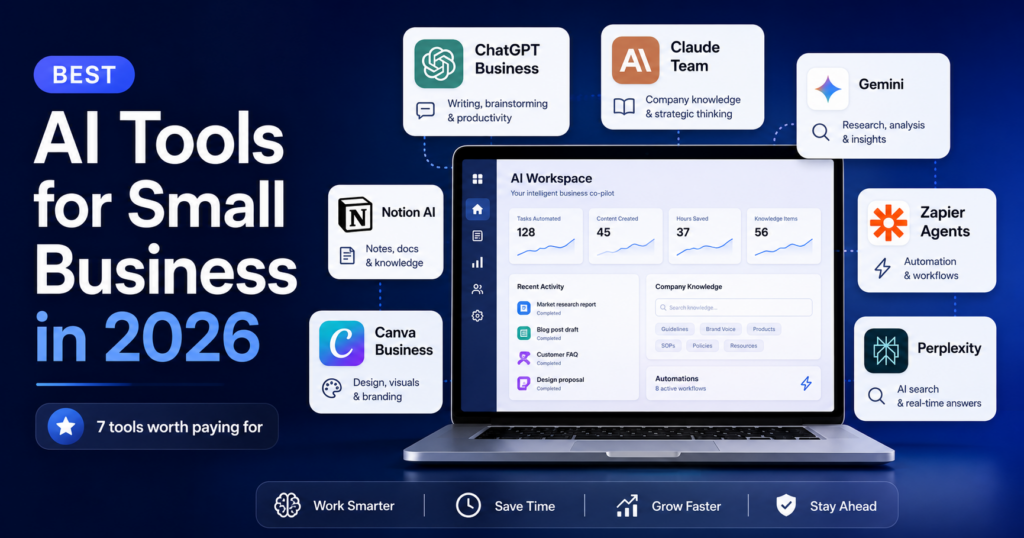
Best AI Tools for Small Business: Quick Picks
| Tool | Best for | Current business pricing* |
|---|---|---|
| ChatGPT Business | Best overall AI workspace | $20/user/month annual; $25 monthly |
| Claude Team | Writing, knowledge work, coding and long-form tasks | $20/standard seat/month annual; $25 monthly |
| Google Workspace + Gemini | Businesses already using Gmail, Docs, Sheets and Meet | Business Standard from $14/user/month annual in the US |
| Notion Business + AI | Company knowledge, projects and AI agents | $20/member/month |
| Canva Business | Marketing design and AI creative production | $20/person/month |
| Zapier Agents | AI automation across business apps | Free; Pro $33.33/month annual |
| Perplexity Enterprise Pro | Research and source-backed business search | $40/seat/month or $400/year |
*Pricing shown is based on current official US or USD pricing at the time of writing. Taxes, regional pricing, billing cycles, usage credits and promotions can change the final cost.
1. ChatGPT Business — Best Overall AI Tool for Small Business
Best for: general productivity, analysis, writing, coding, research, files, workflows and team AI adoption.
ChatGPT Business is our strongest all-round recommendation because it covers more business use cases than almost any single-purpose AI product.
OpenAI’s current business pricing page describes ChatGPT Business as a secure workspace with access to ChatGPT and Codex, company context, connectors, team agents, centralized administration and business privacy controls.
Current pricing is $20 per user per month when billed annually or $25 per user per month when billed monthly, with a minimum of two standard seats.
What ChatGPT Business can replace or reduce
Depending on the business, ChatGPT can reduce time spent across several categories:
- drafting emails and documents;
- summarizing long files;
- analyzing spreadsheets and data;
- researching markets and competitors;
- creating plans and reports;
- writing and reviewing code;
- generating internal documentation;
- working with connected business tools;
- creating specialized team agents;
- handling repetitive knowledge work.
Business connectors and company context
One reason the Business plan is more useful than treating ChatGPT as an isolated chatbot is its ability to connect with company tools.
OpenAI currently lists integrations with products such as Microsoft 365, Google Drive, Slack, GitHub, Linear and Figma, among others.
This changes the workflow from:
“Copy information into AI, ask a question, copy the answer back.”
to:
“Let the AI work with the information and tools the team already uses.”
Privacy
OpenAI states that business data is not used to train its models by default on ChatGPT Business.
For companies, this distinction matters. Consumer AI tools and business workspaces should not automatically be treated as equivalent when confidential information is involved.
Main drawback
Small teams must purchase at least two standard ChatGPT Business seats. A solo founder may therefore find an individual plan more economical until collaboration and administrative controls become important.
ToolMetria verdict: If a small business is only going to pay for one broad AI platform, ChatGPT Business is our current first choice.
2. Claude Team — Best for Writing, Coding and Deep Knowledge Work
Best for: long-form writing, document analysis, coding, complex reasoning and professional knowledge work.
Claude has become much broader in 2026.
Anthropic’s current pricing page lists Claude Team for organizations of two to 150 people, with Standard and Premium seat options.
A Standard Team seat currently costs $20 per user per month on annual billing or $25 monthly. Premium seats are significantly more expensive but include substantially more usage.
What is included?
Claude Team currently includes access to capabilities such as:
- Claude chat;
- Claude Code;
- Claude Cowork;
- Claude Design;
- Claude Science;
- enterprise search;
- connectors;
- central billing and administration;
- SSO;
- projects and shared organizational context.
Anthropic also states that Team content is not used for model training by default.
Claude Sonnet 5
Anthropic released Claude Sonnet 5 in June 2026. Anthropic positions it as a stronger agentic model for coding, tool use, reasoning and knowledge work.
For small businesses, the exact model name matters less than the workflow. Claude is particularly compelling when the work involves:
- large documents;
- careful writing;
- structured analysis;
- software development;
- multi-step research;
- long-running professional tasks.
ChatGPT Business vs Claude Team
This is one of the most important AI comparisons for small businesses.
We currently prefer ChatGPT Business as the broader all-round workspace.
We would choose Claude Team when writing quality, coding workflows, document-heavy work or Claude-specific tools are central to the business.
A dedicated ToolMetria comparison will cover this in greater detail.
3. Google Workspace with Gemini — Best for Businesses Already Using Google
Best for: Gmail, Docs, Sheets, Drive, Meet and teams that want AI integrated into an existing productivity suite.
Google’s AI advantage is distribution.
A small business may already spend most of its day inside:
- Gmail;
- Google Docs;
- Google Sheets;
- Google Drive;
- Google Meet;
- Google Slides;
- Google Calendar.
Gemini can work across that environment without forcing the team to adopt an entirely separate operating system for work.
Google’s current AI for business page lists Google Workspace Business Standard at $14 per user per month with annual commitment in the US at the time of writing.
What Gemini can do inside Workspace
Current Workspace AI features span areas such as:
- writing assistance in Gmail and Docs;
- summarizing information;
- working with files and company data;
- Gemini chat;
- Gemini Notebook;
- AI functions in Sheets;
- video generation and editing features in Vids;
- meeting and collaboration assistance;
- business data controls.
Why it can be better value than a separate AI subscription
If a business already needs professional email, cloud storage, documents, spreadsheets and video meetings, Gemini is part of a much larger productivity purchase.
This makes comparing “$14 Workspace vs $20 AI assistant” misleading.
Workspace is not only an AI subscription. It is also the company’s office suite.
Privacy
Google states that company data in its business AI offering is not used to train AI models or for advertising.
ToolMetria verdict: For Google-centric companies, Workspace with Gemini may provide more practical daily value than adding another isolated AI assistant to every employee.
4. Notion Business — Best AI Tool for Company Knowledge and Projects
Best for: documentation, project management, company knowledge, meetings and AI agents working from internal context.
Notion has evolved from a flexible note-taking product into a much more AI-native workspace.
Its current Business plan is listed at $20 per member per month.
The current Business package includes features such as:
- Notion Agent;
- AI Meeting Notes;
- enterprise search across connected apps;
- projects and databases;
- forms;
- company knowledge;
- SSO;
- advanced permissions.
Why Notion AI is different
The key advantage is context.
Notion can work from information that already lives inside the company workspace: project plans, meeting notes, databases, product documentation, roadmaps, policies and internal knowledge.
An AI tool becomes much more useful when it does not need the employee to explain the company from scratch in every conversation.
Notion agents and workers
Notion is also moving toward agentic automation.
Its 2026 documentation describes custom agents and Workers that can carry out background tasks. These advanced workflows can use Notion credits, so businesses planning extensive autonomous automation should monitor usage costs.
Main drawback
Notion can become messy when a company has no information architecture.
AI does not solve a badly organized workspace automatically. Good naming, databases, permissions and documentation still matter.
ToolMetria verdict: Notion Business is one of the most compelling AI investments for teams whose knowledge and projects already live in Notion.
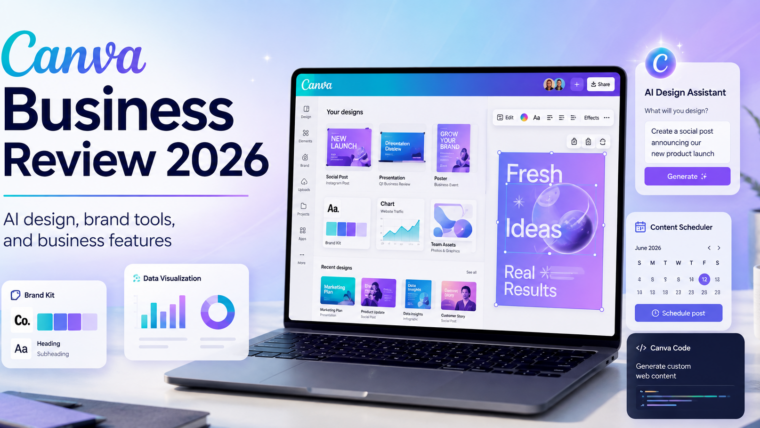
5. Canva Business — Best AI Tool for Marketing Design
Best for: social media, ads, presentations, brand assets, marketing graphics, AI images and visual content.
Small businesses rarely need only text.
They need:
- Instagram posts;
- ads;
- presentations;
- flyers;
- product graphics;
- videos;
- logos;
- sales materials;
- campaign assets.
Canva Business is designed around this problem.
Canva’s official Business announcement lists the plan at $20 per person per month with no seat minimum.
What Canva Business adds
Canva positions Business between Canva Pro and Enterprise and includes:
- everything in Canva Pro;
- higher access to premium AI tools;
- advanced brand management;
- marketing insights;
- team collaboration;
- Leonardo.Ai Essential access;
- Flourish Presenter access;
- expanded creative and marketing capabilities.
AI Pass
Canva also sells an optional AI Pass for users who need much larger AI allowances.
Canva says AI Pass can provide up to 20 times the AI usage available with Canva Business, depending on the feature mix.
This is important for teams producing AI images, video and design at high volume.
Main drawback
Canva is not a replacement for ChatGPT, Claude or a research product. It is strongest when AI is being used to create and transform visual marketing assets.
ToolMetria verdict: For a small business that regularly produces its own marketing materials, Canva Business is one of the easiest AI subscriptions to justify.
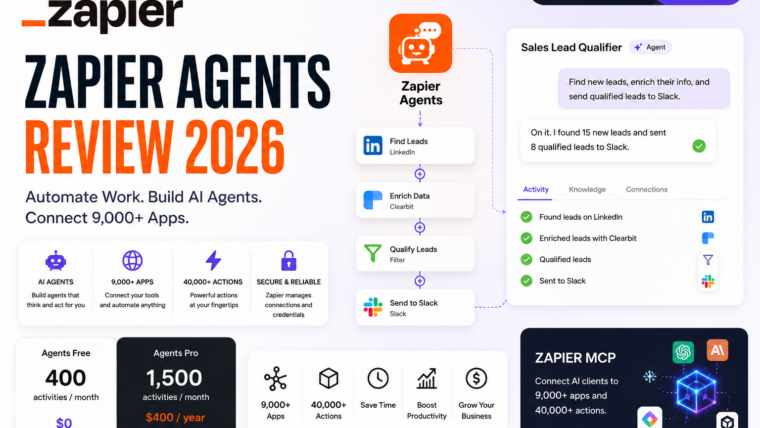
6. Zapier Agents — Best AI Tool for Automation
Best for: delegating repetitive tasks across apps and building AI-powered operational workflows.
Traditional automation follows rules:
When X happens → do Y.
AI agents introduce more flexible behavior:
Understand the goal → use the available tools → decide what actions are needed → execute them.
Zapier’s Agents product is designed around this model and can connect agents to thousands of business applications.
Zapier currently advertises integration with more than 9,000 apps.
Zapier Agents pricing
The current Zapier pricing page lists:
- Agents Free: 400 activities per month;
- Agents Pro: $400 billed annually, equivalent to $33.33/month, with 1,500 activities per month;
- Agents Enterprise: custom pricing.
What counts as an activity?
Zapier measures Agents usage by activities. An activity can be an action performed by the agent, web browsing, a chat interaction or information retrieval from connected data.
This makes usage limits important. A complicated agent can consume multiple activities during a single run.
Good small-business use cases
Examples include:
- researching and enriching leads;
- drafting follow-up messages;
- checking incoming requests;
- updating CRM records;
- collecting information across applications;
- preparing reports;
- monitoring data and taking action;
- routing work to the right person.
ToolMetria verdict: Zapier Agents is one of the most interesting tools for businesses that already use several SaaS products and want AI to perform real work between them.
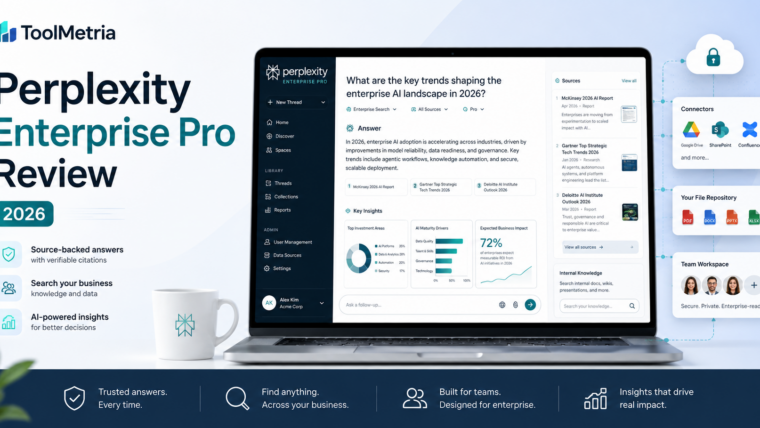
7. Perplexity Enterprise Pro — Best for AI Research
Best for: source-backed research, market intelligence, competitive analysis and internal knowledge search.
Perplexity is designed around research rather than general-purpose document creation.
The product combines AI answers with sources and web search, which can make it more useful than a standard chatbot when the business needs to understand where information came from.
Perplexity’s current Enterprise pricing documentation lists:
- Enterprise Pro: $40 per user per month or $400 per year;
- Enterprise Max: $325 per user per month or $3,250 per year.
What Enterprise Pro adds
Current Enterprise Pro capabilities include:
- business privacy controls;
- team administration;
- internal file repositories;
- organizational knowledge search;
- higher file-upload limits;
- collaborative projects;
- dedicated support;
- enterprise billing and administration.
When Perplexity is worth paying for
A business does not need another AI subscription simply because it exists.
Perplexity makes the most sense when research is a recurring part of the job:
- consulting;
- investment research;
- marketing;
- competitive intelligence;
- sales preparation;
- product research;
- strategy;
- journalism or content research.
ToolMetria verdict: Perplexity is our current specialist pick when reliable web research and source discovery matter more than having one general AI workspace.
Which AI Tools Does a Small Business Actually Need?
The biggest mistake is buying all seven.
Most small businesses should start with a simple stack.
Option 1: The simplest AI stack
- ChatGPT Business for general AI work;
- Canva Business for visual marketing;
- existing business software for everything else.
This already covers an enormous amount of work.
Option 2: Google-first business
- Google Workspace + Gemini for daily office work;
- Canva Business for marketing;
- Zapier Agents when automation becomes valuable.
Option 3: Knowledge-heavy team
- Claude Team or ChatGPT Business for deep AI work;
- Notion Business for internal knowledge and projects;
- Perplexity Enterprise Pro if external research is central to the business.
Option 4: AI-heavy operations
- ChatGPT Business or Claude Team;
- Zapier Agents;
- Notion Business;
- specialist tools only when a clear workflow requires them.
How Much Would This AI Stack Cost?
AI subscriptions can become expensive surprisingly quickly.
For example, a two-person business could easily pay for:
- ChatGPT Business: at least two seats;
- Canva Business: one or two seats;
- Notion Business: two seats;
- Zapier Agents Pro;
- another research or design subscription.
That can push the software bill well above $100 per month before accounting for CRM, accounting, email, hosting, project management and other business software.
Every tool should therefore answer a simple question:
What recurring work does this subscription eliminate or materially improve?
If the answer is vague, do not add the subscription yet.
Best AI Tool for a One-Person Business
A solo operator should be even more selective.
ChatGPT Business and Claude Team both currently require at least two organizational seats, which can make individual plans more economical for one person.
Canva Business is unusual because Canva explicitly allows a single-person Business subscription.
Notion, Workspace and specialist tools should be evaluated based on whether they replace software you already need.
Best AI Tool for Marketing
Our pick depends on the type of marketing.
- Copy, strategy and analysis: ChatGPT or Claude;
- Visual content: Canva Business;
- Research: Perplexity;
- Automation: Zapier Agents;
- campaign documents and team workflows: Notion or Google Workspace.
The strongest marketing stack is usually a combination rather than a single product.
Best AI Tool for Research
Perplexity is our specialist choice.
ChatGPT and Claude also have strong research capabilities, but Perplexity’s product identity remains tightly centered on search, sources and research workflows.
Best AI Tool for Writing
Claude and ChatGPT are our top two.
Claude is particularly strong for long-form material and document-heavy work. ChatGPT offers a broader workspace around writing, analysis, files, agents and connected tools.
Best AI Tool for Design
Canva Business is the obvious small-business choice.
It is not trying to replace professional tools for every designer. It is designed to let ordinary businesses create competent marketing assets quickly.
Best AI Tool for Automation
Zapier Agents is our current pick because automation is Zapier’s core business and the agent system can operate across thousands of existing software integrations.
What About AI Website Builders?
Website building is large enough that we treat it as a separate category.
If your goal is specifically to create a business website with AI, see our guide to the Best AI Website Builders in 2026, where we compare Wix, Hostinger, Framer, Webflow, Squarespace and other platforms.
How We Evaluate AI Tools for Small Business
ToolMetria evaluates business AI products around practical outcomes rather than the number of AI features on a landing page.
Our framework focuses on:
- Usefulness: Does it solve recurring business work?
- Output quality: Is the result usable without excessive correction?
- Control: Can the user verify, edit and override AI output?
- Integrations: Can it work with the company’s existing software?
- Privacy: Are business data policies clearly explained?
- Reliability: Can a team build repeatable workflows around it?
- Pricing: Is the real cost clear?
- Usage limits: Are credits, activities, messages or seats likely to become a constraint?
- Learning curve: How much setup is required before the tool saves time?
- Value: Does it replace enough work or software to justify the subscription?
AI Tool Buying Checklist
Before paying for another AI product, answer these questions:
- What exact task will we use it for every week?
- Can one of our existing tools already do this?
- Does the product have a business privacy policy suitable for our data?
- Does the plan have seat minimums?
- Are there usage credits or activity limits?
- Will we need paid add-ons?
- Can it integrate with our existing software?
- How difficult is it to remove later?
- Who will actually use it?
- How will we measure whether it saves money or time?
Frequently Asked Questions
What is the best AI tool for small business in 2026?
ChatGPT Business is our current best all-round choice because it covers writing, research, analysis, coding, files, connected tools, workflows and team AI use in one platform. The best specialist tool depends on the job.
Is ChatGPT Business worth it for a small business?
It can be, especially for teams that use AI across several functions. Current pricing is $20 per user per month on annual billing or $25 monthly, with at least two standard seats required.
Which AI tool is best for marketing?
Canva Business is our visual-marketing pick, while ChatGPT and Claude are stronger for strategy, writing and analysis. Many teams will get the best result by combining one general AI assistant with Canva.
Which AI tool is best for research?
Perplexity is our specialist research recommendation because the product is designed around web search, sources and research workflows.
Which AI tool is best for automation?
Zapier Agents is one of the strongest options for small businesses because its agents can work across more than 9,000 connected applications and perform multi-step business tasks.
Is Claude better than ChatGPT for business?
Claude can be particularly strong for writing, coding, documents and long-form professional work. ChatGPT Business currently provides the broader all-round workspace. The better choice depends on the team’s actual workflows.
Do small businesses need multiple AI tools?
Usually not at first. Start with one general AI platform and add specialist tools only when a recurring workflow justifies the extra subscription.
Final Verdict
The best AI stack for a small business in 2026 is not the one with the most subscriptions.
It is the smallest collection of tools that removes meaningful work.
ChatGPT Business is our current all-round winner.
Claude Team is one of the strongest alternatives for deep knowledge work and coding.
Google Workspace with Gemini makes enormous sense for teams already living inside Google’s ecosystem.
Notion Business is our knowledge-workspace pick.
Canva Business is the easiest recommendation for marketing design.
Zapier Agents is our automation pick.
Perplexity Enterprise Pro is our specialist research pick.
The next step for most businesses should not be buying all of them. Start with the one tool that addresses the largest recurring workload, measure whether it actually saves time, and expand from there.